Electric Kettle Buying Guide for GCC Homes | Samaya Store
If you’ve ever stood in front of a shelf of electric kettles wondering why one costs 40 riyals and another costs 200, you’re not alone. Most people buy the first one that looks nice, use it for six months, and then wonder why it’s leaking, rusting, or taking forever to boil.
In a home in Bahrain, Riyadh, or Dubai, a kettle isn’t a small appliance. It’s the thing that makes your morning karak, your evening qahwa, and every guest’s first cup of tea. It gets used more than almost anything else in the kitchen. So it’s worth five minutes to understand what actually matters before you buy one.
This guide walks through exactly that in plain language, with GCC homes specifically in mind.
Why Kettles Behave Differently in GCC Homes?
Three things make this region a little different from, say, buying a kettle in Europe.
The water is harder. Saudi Arabia, the UAE, and Bahrain all rely heavily on desalinated water, and depending on your building’s plumbing and storage tanks, mineral buildup happens faster than most people expect. A kettle without a proper filter or an easy-to-clean interior will scale up within weeks.
The voltage is 220–240V. Any kettle sold locally through a proper retailer should already match this, but it’s worth double-checking if you’re importing one yourself or buying from an overseas marketplace.
Kettles get used constantly. Ramadan alone can mean three or four boils a day for suhoor and iftar. A cheap, thin-walled kettle simply wears out faster under that kind of daily use.
None of this means you need to overspend. It means you need to buy for how your household actually uses a kettle, not for how it looks in a photo.
The Six Things That Actually Matter
1. Capacity – Match It to Your Household
- 1.0–1.2L – one or two people, occasional tea or coffee
- 1.5–1.7L – a small family, regular hot drinks
- 1.8–2.0L – larger households, guests, or offices that need to serve several people back to back
A bigger kettle isn’t automatically better. If you’re mostly boiling one cup at a time, a 1.8L kettle wastes both water and electricity every single time you use it.
2. Wattage – Speed Versus Power Draw
Wattage decides how fast your water boils. Most home kettles fall between 1200W and 1800W.
A 1500W kettle is the sweet spot for most GCC households fast enough that you’re not standing around waiting, without pulling excessive current on a shared kitchen circuit. Anything under 1000W will feel noticeably slow once you’re used to a faster one.
3. Material – What the Kettle Is Actually Made Of
- Stainless steel holds up best against heat, daily use, and hard water. It won’t crack, discolor, or hold onto odors the way some plastics can over time.
- BPA-free plastic is lighter and often cheaper, but quality varies a lot between brands.
- Glass kettles look great and let you see the water level, but they’re the most fragile option for a busy kitchen.
For a household that boils water multiple times a day, stainless steel is usually the more sensible long-term choice.
4. Safety Features You Shouldn’t Skip
- Auto shut-off when water reaches boiling point
- Boil-dry protection, which cuts power if the kettle is switched on empty
- A cool-touch handle, especially important in homes with children
These aren’t luxury extras. In a kitchen where the kettle might be used by anyone in the household, they’re basic protection against a burn or a fire hazard.
5. Cordless, 360° Base Design
Almost every modern kettle now sits on a separate power base rather than having a fixed cord. This matters more than people realize. it means you can lift the kettle and pour from any angle, and there’s no cord dragging across a hot stovetop or getting in the way near young children.
6. Warranty and After-Sales Support
A kettle is a heating appliance, so a proper warranty matters more here than it does for, say, a plastic mixing bowl. Look for at least a one-year warranty, and ideally two. It’s a fair signal that the manufacturer trusts the build quality.
A Practical Example
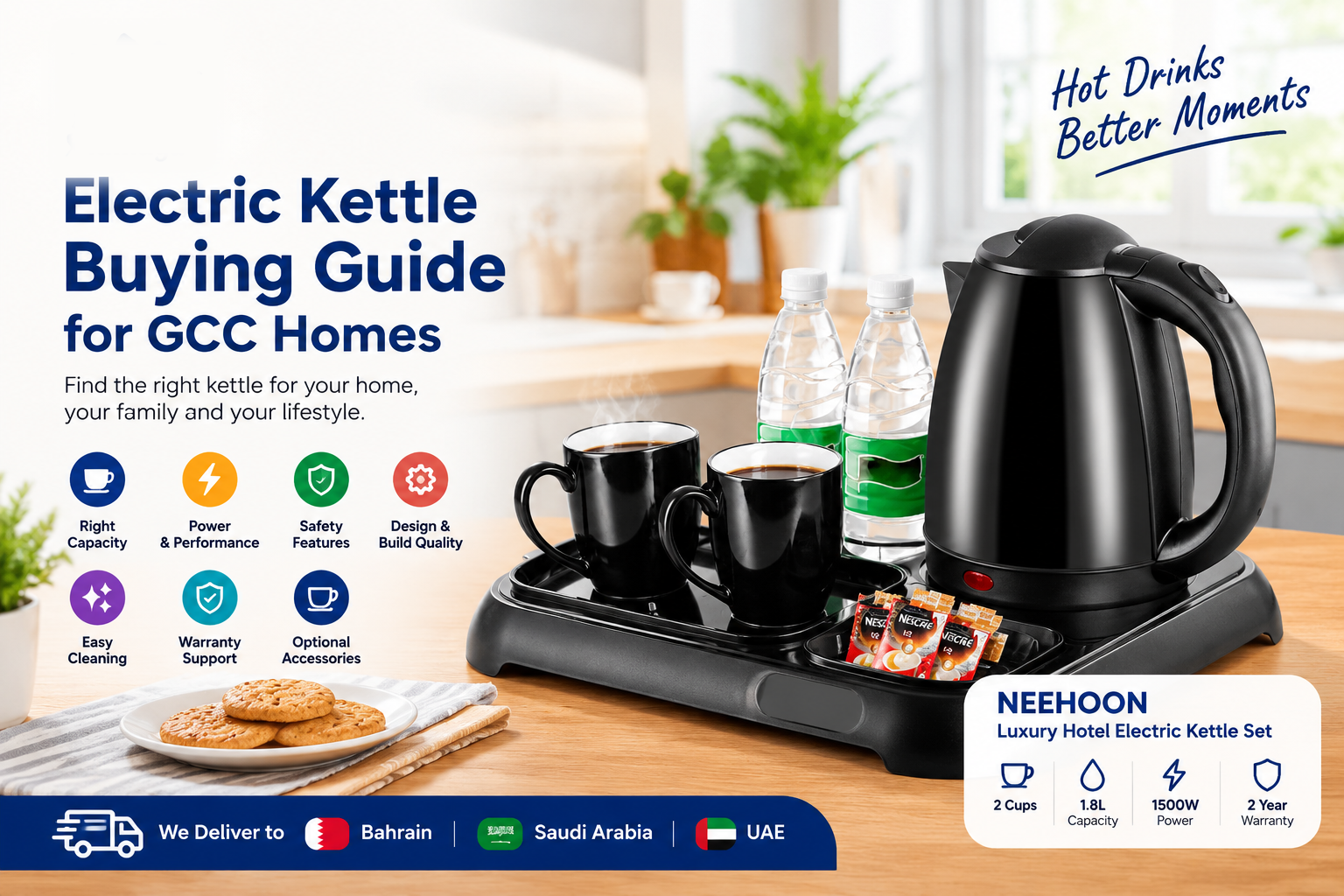
“The NEEHOON Luxury Hotel Electric Kettle Set is a good illustration of these factors working together in one product: an 1500W stainless-build kettle with an 1.8L capacity, matched with two cups, and backed by a two-year warranty. It’s built with hospitality-grade use in mind, which in practice just means it’s designed to be boiled repeatedly, day after day, without wearing out exactly the kind of daily demand a GCC household or small guesthouse puts on it.“
Common Questions About Electric Kettles in the GCC
How many watts is good for a home electric kettle?
1500W is ideal for most households. It boils quickly without overloading a shared kitchen circuit, and it’s the wattage used in most mid-to-premium kettles sold in the region.
Is stainless steel really better than plastic for a kettle?
For daily, heavy use yes. Stainless steel resists scaling, doesn’t absorb odors, and holds up better against the hard, mineral-rich water common across Bahrain, Saudi Arabia, and the UAE.
What size kettle does a family of four need?
A 1.5L to 1.8L kettle is usually enough to cover a family of four without repeated reboiling, especially if you regularly make tea or coffee for the whole household at once.
Do kettles need descaling more often in GCC homes?
Yes, typically. Because of harder, desalinated tap water, a light descale every two to four weeks (using diluted white vinegar or a kettle-specific descaling solution) keeps performance and taste consistent.
Is auto shut-off a necessary feature or just a nice-to-have?
It’s necessary. Beyond convenience, it protects the heating element from damage and lowers fire risk if the kettle is accidentally left switched on.
Do you deliver electric kettles to Bahrain, Saudi Arabia, and the UAE?
Yes. Orders are shipped and fulfilled across Bahrain, Saudi Arabia, and the UAE, with secure payment options at checkout.
If you only remember three things from this guide: go with 1500W for a good balance of speed and safety, choose stainless steel if you boil water more than a couple of times a day, and don’t buy a bigger kettle than your household actually needs. Everything else the base design, the warranty, the extra cups is a bonus on top of those fundamentals.
A good electric kettle should be something you stop thinking about once it’s in your kitchen. Get these basics right, and it will be.